Beyond the Clipboard: The Growing Pressure on Condominium Managers and the Records That Protect Them
· By Sunni Dowds · Governance
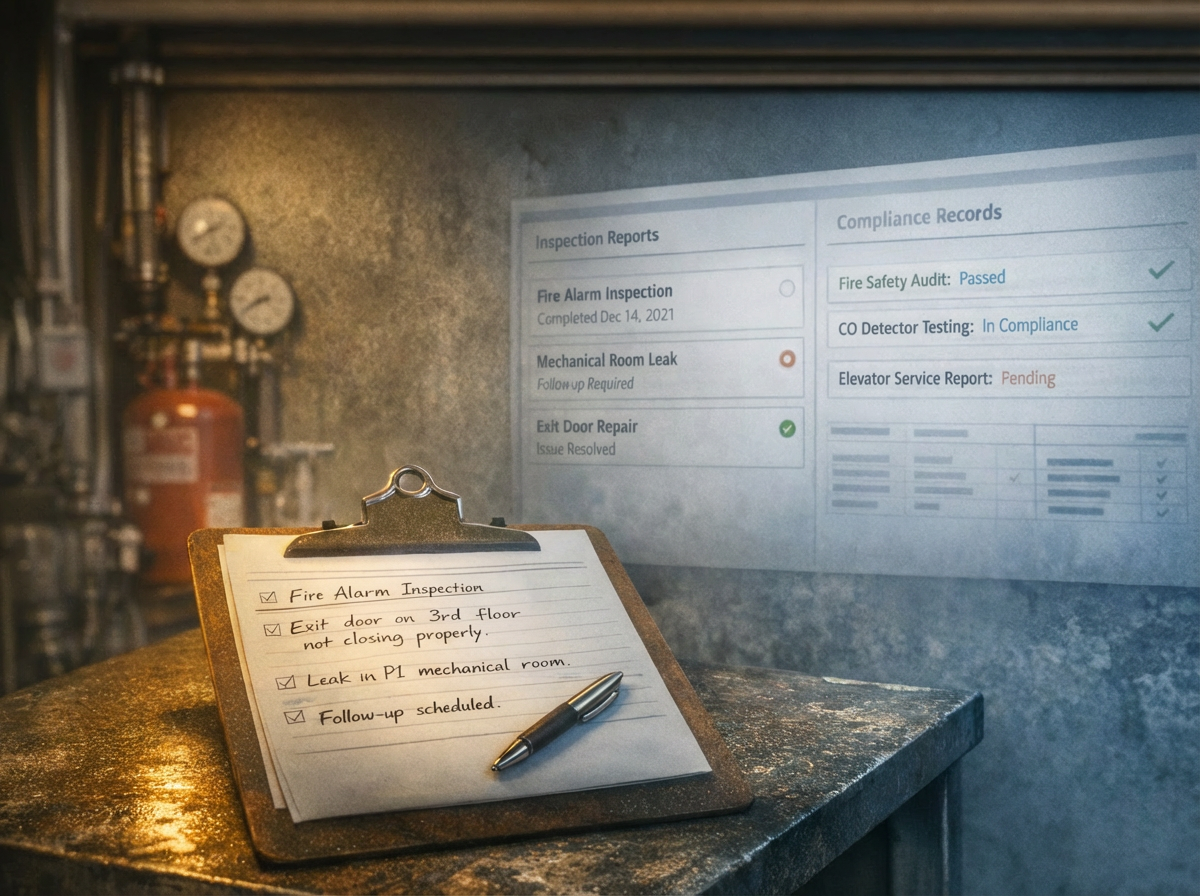
When the record matters more than the repair. What Ontario tribunal decisions and fire safety enforcement are teaching condominium managers about documentation, compliance, and the operational history of their buildings.
When the record matters more than the repair. What Ontario tribunal decisions and fire safety enforcement are teaching condominium managers.
Across Ontario's condominium sector, two conversations are becoming increasingly common.
One centres on governance, regulation, and compliance.
The other focuses on the growing pressure placed on condominium managers.
These conversations are not separate issues. They are connected.
As expectations around governance, safety, and transparency increase, the operational work of managers is increasingly expected to be supported by clear, defensible documentation.
This shift has quietly changed the profession.
A Profession Operating in a More Regulated Environment
Condominium management in Ontario now operates within a structured regulatory framework overseen by the Condominium Management Regulatory Authority of Ontario.
Managers must maintain licensing, meet education requirements, and operate within defined supervisory structures.
At the same time, the Condominium Authority of Ontario has introduced new mechanisms for addressing disputes through the Condominium Authority Tribunal.
Many tribunal matters involve records disputes, where owners exercise their statutory right under Section 55 of the Condominium Act to access corporate records.
These cases reinforce an important operational reality.
When questions arise, corporations are expected to produce the records that exist, not explanations created after the fact.
For managers, that distinction matters.
The operational history of a building increasingly lives within the documentation created during day-to-day operations.
When the Record Becomes the Issue
A useful example comes from Jalbout v. Carleton Condominium Corporation No. 272.
In this matter, the tribunal considered a dispute regarding access to condominium records. The case reinforced that owners are entitled to the records maintained by the corporation, not interpretations or explanations created later to clarify decisions.
The lesson for managers is straightforward.
If operational decisions are not documented at the time they occur, the corporation may later find itself unable to clearly demonstrate what actions were taken. The tribunal cannot review memories. It reviews records.
Fire Safety and the Importance of Compliance Records
Fire safety provides another example of how operational documentation can become a regulatory issue.
Updates to Ontario's fire safety framework continue to strengthen expectations around life safety systems, including carbon monoxide detection and compliance oversight in residential buildings.
Routine fire alarm inspections, life safety checks, and contractor reports are not simply operational tasks. They form part of the regulatory record of the building.
If a fire department inspection occurs or if an incident is investigated, one of the first questions asked will be simple.
What documentation exists demonstrating the corporation exercised due diligence?
In many situations the answer depends entirely on the operational records maintained by management.
A Court Case That Reinforces the Responsibility
The importance of responding to safety concerns was highlighted in York Condominium Corporation No. 221 v. Mazur.
In this matter serious fire safety concerns were identified within a unit. The conditions created potential hazards that could affect other residents in the building.
The condominium corporation sought a court order requiring the owner to address the hazard. The court supported the corporation's actions and confirmed that condominium corporations have a responsibility to intervene when safety issues threaten the community.
For managers the lesson is not that every issue will escalate to court.
The lesson is that when safety concerns arise the corporation must be able to demonstrate:
- When the issue was identified
- Who was notified
- What action was taken
- Whether follow up occurred
Those answers come from documentation.
Another Example of Enforcement Responsibility
Another Ontario case that illustrates the importance of enforcement and documentation is Metropolitan Toronto Condominium Corporation No. 747 v. Korolekh.
In this matter the corporation sought court intervention relating to safety and compliance concerns within a unit. The court reinforced that condominium corporations have both the authority and responsibility to act when conditions within a unit threaten the safety or integrity of the building.
Cases such as this highlight a critical operational principle. When concerns are identified the corporation must be able to demonstrate that it responded appropriately. Clear operational records are often the foundation of that demonstration.
Service Requests and Workflow Systems
Many condominium communities now use resident platforms or property management software that include service requests and workflow systems. These tools have significantly improved communication and operational coordination.
However, there is sometimes an assumption that because a task exists within a digital system sufficient documentation automatically exists.
That assumption can create gaps.
A service request platform may show that:
- A complaint was received
- A work order was issued
- A vendor attended
- The task was closed
Operationally the issue appears resolved. From a governance perspective important information may still be missing.
- What condition was actually observed
- Did the issue involve a life safety component
- Was the repair verified afterward
- Was follow up inspection completed
Closing a task does not necessarily create a complete operational record.
The Hidden Pressure on Managers
This is where many managers experience one of the hidden pressures within the profession.
Not because they failed to address the issue. But because they may later be expected to reconstruct events months or even years after they occurred.
If inspection notes exist in one system, vendor reports in another, and operational observations in emails or handwritten notes, the manager often becomes the only person capable of explaining what happened.
That expectation can be exhausting.
It is one reason conversations about workload, burnout, and mental health have become more visible within the condominium management community. The pressure does not come only from managing buildings. It comes from managing the institutional memory of those buildings.
Practical Lessons for Managers
For managers, particularly those early in their careers or working under a limited licence, several simple practices can strengthen operational records.
Document observations, not just tasks
Instead of recording only that work was completed, note what was observed and how the issue was addressed.
Level 2 stairwell door not closing fully during security patrol. Maintenance attended and adjusted closer. Door confirmed to close properly during follow up inspection.
Record follow up when safety is involved
When issues involve doors, alarms, lighting, access control, or other safety components, confirming that corrective work resolved the issue creates a stronger operational record.
Separate inspections from resident requests
Service requests capture one type of operational information. Many building issues are first identified by staff, contractors, or routine inspections. Maintaining structured inspection records ensures these observations are preserved.
Write records assuming they may be reviewed later
Inspection notes may eventually be reviewed by Boards, auditors, insurers, lawyers, or regulators. Clarity today prevents confusion tomorrow.
Looking Beyond the Clipboard
The clipboard has long symbolized the daily work of condominium managers. Walking buildings. Observing issues. Coordinating repairs.
But the profession is evolving.
Managers today are not simply overseeing buildings. They are maintaining the operational history of those buildings.
As regulatory oversight, safety expectations, and governance scrutiny continue to increase across Ontario's condominium sector, that operational history becomes increasingly important.
When questions arise from residents, Boards, insurers, or regulators, the answer rarely comes from memory. It comes from the record.
As condominium governance continues to evolve in Ontario, the operational systems supporting managers must evolve with it.
The work performed in a building matters, but the clarity of the record created from that work may ultimately matter even more. And increasingly, that record needs to go beyond the clipboard.
Condo Inspect Pro helps condominium managers replace fragmented inspection workflows with structured, repeatable, defensible processes. From building profiles and standardized templates to board-ready reports and deficiency tracking — everything is designed for Ontario condo operations. Learn more about why purpose-built inspection software matters, review common questions from Ontario managers, or request a demo.
Start with one building. See the difference for yourself.
This article reflects the author's professional experience in Ontario condominium management. References to tribunal decisions and court cases are included for educational context. Consult your property management team and legal counsel for specific guidance applicable to your properties.
Frequently Asked Questions
Why is inspection documentation important for Ontario condominium managers?
Ontario condominium managers operate under regulatory oversight from the CMRAO, governance obligations under the Condominium Act, 1998, and fire safety requirements under the Ontario Fire Code. Structured inspection documentation demonstrates due diligence when records are reviewed by tribunals, fire marshals, insurers, or boards.
What records can the Condominium Authority Tribunal review?
The CAT can review records maintained by the condominium corporation. Owners have rights under Section 55 of the Condominium Act to access corporate records. The tribunal reviews documentation that exists — not explanations created after the fact.
How does the Ontario Fire Code affect condominium inspection documentation?
The Ontario Fire Code (O. Reg. 213/07) requires condominium corporations to maintain fire safety plans and demonstrate regular inspection of life safety equipment including fire alarms, sprinkler systems, emergency lighting, and carbon monoxide detection.
What is the difference between a service request and an inspection record?
Service requests capture reactive information — a complaint was received, a work order was issued, a task was closed. Inspection records capture proactive observations — what condition was observed, whether safety was involved, whether follow-up was verified.
How can condominium managers protect themselves with better documentation?
By documenting observations at the time they occur with timestamped photos, condition assessments, and follow-up records. Purpose-built inspection software creates structured records that survive audits, legal challenges, and personnel changes.