Beyond the Clipboard: The Real Reason Chargebacks Get Challenged
· By Sunni Dowds · Operations
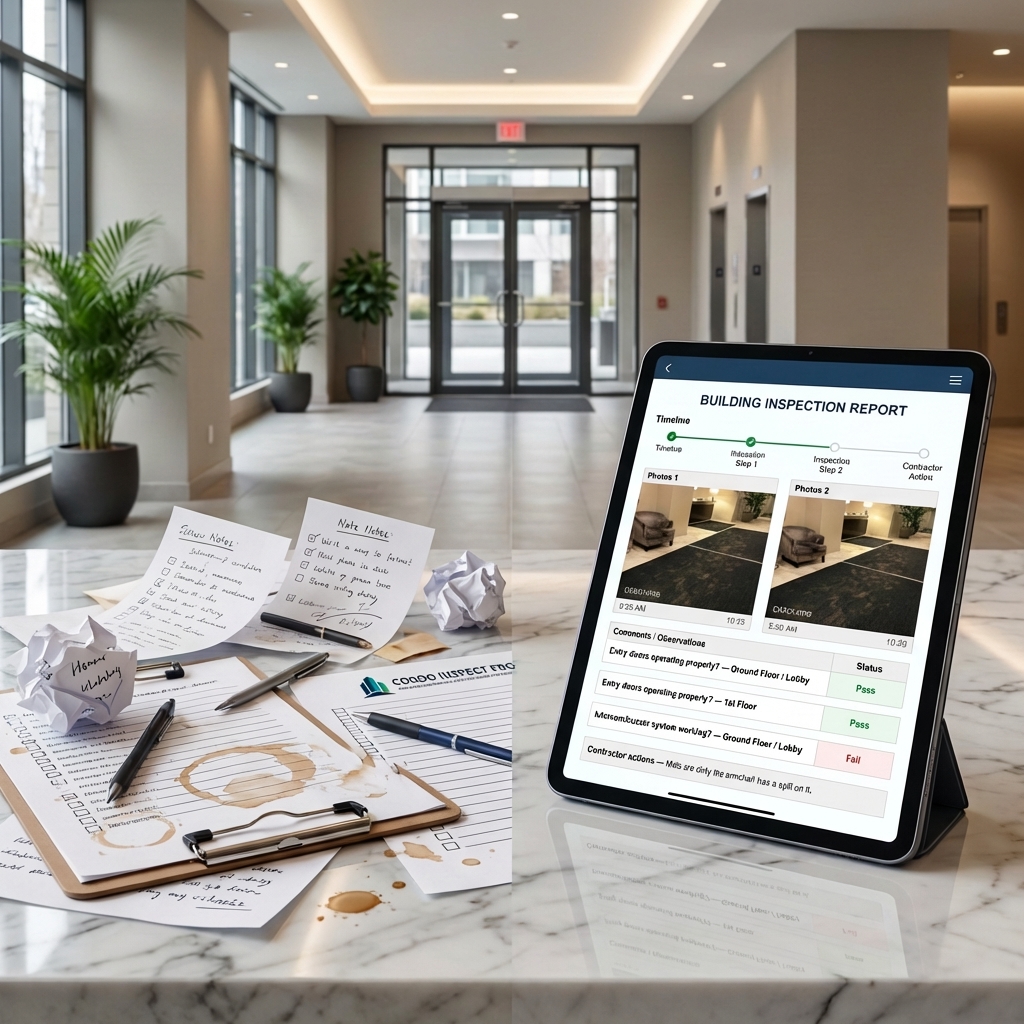
Chargebacks get challenged because the file cannot clearly show the sequence of events that led to the cost. The Condominium Act allows corporations to recover costs, but the authority to charge back is only as strong as the documentation supporting it.
Chargebacks are one of the most consistently challenged items in condominium operations. The issue is rarely the cost or the decision to proceed. It is whether the file can clearly show the sequence of events that led to the charge.
The Condominium Act allows corporations to recover costs from an owner where damage or additional expense is caused by the act or omission of the owner or someone they are responsible for. In practice, however, the authority to charge back is only as strong as the documentation supporting it.
A contractor attends site. An issue is addressed. Time and cost are incurred.
But when the file is reviewed later, it often cannot clearly answer what happened, who was responsible, and how that responsibility was confirmed.
At the same time, the communication to the unit owner is frequently reactive rather than structured. Owners receive a charge, but not always a clear, documented explanation that ties the issue, the responsibility, and the cost together.
That is where friction starts between managers, boards, and owners.
In most cases, the issue is not whether the work should have been charged back. The issue is whether the file can clearly support the decision.
The Three Consistent Documentation Gaps
There are a few consistent gaps that create vulnerability in chargeback files.
- Lack of Clarity on What Was Observed — Notes may indicate that a leak was found or that damage was present, but they do not always describe the condition in a way that can be understood later without relying on memory.
- How Responsibility Was Determined — Responsibility is often assumed based on location or past history, but not always documented in a way that shows how that conclusion was reached. If responsibility is not clearly supported in the record, it becomes difficult to defend when questioned.
- Scope of Work Completed — Invoices may be attached, but they do not always align clearly with the issue that triggered the chargeback. Without that connection, the cost can appear disconnected from the original problem.
Where Communication Becomes the Weak Point
Communication with the unit owner is where many files become vulnerable — not because notice was not sent, but because the full sequence of events is not clearly documented.
Immediate Risk vs. Reasonable Notice: In situations where there is an immediate risk to property, common elements, or other units, the corporation may need to act without delay. The record should clearly show what was observed and why immediate action was required.
Where the condition does not present an immediate risk, the expectation is that the owner is provided with reasonable notice and a defined period of time to correct the issue.
That process should be documented in a way that can be followed step by step.
The Required Sequence of Documentation
A defensible chargeback file documents a clear, traceable sequence from initial observation through to the final cost applied:
- The initial observation during inspection, clearly describing what was identified
- Communication to the owner outlining the issue and required action
- The timeline provided for correction
- Follow-up inspections to confirm whether the work was completed within that timeframe
- When the contractor was engaged, what work was performed, and how it relates to the original issue
Without that continuity, the chargeback can appear disconnected from the events that led to it. From the owner's perspective, it may feel abrupt or unsupported, even if the underlying decision was reasonable.
When the Sequence Breaks Down
The issue is not a lack of activity. It is a lack of a clearly documented sequence.
When the sequence is not clearly documented, the issue does not stay operational. It becomes a dispute.
From the owner's perspective, the concern is not always the cost itself. It is whether the charge feels justified and whether they were given a fair opportunity to address the issue before the corporation intervened.
If the record cannot clearly show what was observed, what was communicated, and what opportunity was provided, the chargeback becomes difficult to understand and, in many cases, difficult to accept.
The Pressure on Boards and Managers
That is where boards begin to feel pressure. Directors are asked to review decisions after the fact, often without a complete file. Without a clear record, the discussion shifts away from the original issue and toward whether the process was handled correctly.
For Managers: Time is spent reconstructing events, responding to challenges, and supporting decisions that should have been clear from the outset.
For Boards: Directors are asked to defend chargeback decisions without the documentation needed to show the process was fair and consistent.
For Owners: Owners question the process, and without a clear record, the charge feels arbitrary rather than justified.
Over time, this erodes confidence. Owners question the process, boards question the decisions, and managers are left defending files that were never structured to be defended.
What a Defensible Chargeback File Looks Like
The issue is not the authority to charge back. The issue is whether the file can support the decision in a way that is clear, consistent, and fair.
What should be happening is not more documentation for the sake of it. It is better documentation that follows a clear and consistent structure.
- Start With the Initial Observation — Every chargeback should begin with a clearly described initial observation, supported by photos where appropriate. In situations that may lead to a chargeback, this should be elevated to a dedicated incident report so the record remains focused, structured, and tied specifically to the issue.
- Reference Prior History — Where there is a history of similar issues, that history should be referenced within the file. Prior incidents, previous notices, and past corrective actions provide important context and help demonstrate that the issue is not isolated.
- Document Responsibility and Communication — The record should document how responsibility was determined and how that determination was communicated to the unit owner, including when notice was provided and what timeline was given for correction.
- Connect the Contractor's Scope — If the corporation proceeds with the work, the record should connect the contractor's scope directly back to the original issue, with dates, supporting details, and confirmation of completion.
When this structure is in place, the chargeback is no longer a point of debate. It becomes a documented outcome of a clear process.
The Outcome When Documentation Is Right
- For boards: Confidence that chargeback decisions are supported by a complete, defensible record.
- For managers: Reduced need to reconstruct events after the fact, with less time spent responding to challenges.
- For owners: Transparency around what occurred and why the cost was applied.
A chargeback should not need to be explained. The record should make the sequence clear on its own.
What does your chargeback documentation process look like today? Are your files structured to withstand challenge, or are they reactive records assembled after the fact?
Read more about why Ontario managers choose purpose-built inspection software, explore our frequently asked questions, or contact us to discuss how structured documentation supports defensible chargebacks.
Sunni Dowds is a licensed condominium professional with nearly two decades of experience managing Canadian condominiums and the creator of Condo Inspect Pro, a documentation platform designed to support governance-grade inspections and defensible decision-making.
Frequently Asked Questions
Why do condominium chargebacks get challenged by unit owners?
Chargebacks are most often challenged not because of the cost itself, but because the documentation cannot clearly show the sequence of events — what was observed, how responsibility was determined, what notice was given, and how the scope of work connects to the original issue.
What documentation is needed to support a condominium chargeback in Ontario?
A defensible chargeback file should include the initial observation with photos, documentation of how responsibility was determined, communication to the owner with a timeline for correction, follow-up inspections, and a clear connection between the contractor's scope of work and the original issue.
Can a condominium corporation charge back repair costs to an owner?
Yes. The Condominium Act allows corporations to recover costs where damage or additional expense is caused by the act or omission of the owner or someone they are responsible for. However, the authority is only as strong as the documentation supporting it.
What is the difference between immediate action and reasonable notice for chargebacks?
Where there is immediate risk to property, common elements, or other units, the corporation may act without delay — but the record must show why. Where the condition does not present immediate risk, the owner should receive reasonable notice and a defined period to correct the issue before the corporation intervenes.
How does Condo Inspect Pro help with chargeback documentation?
Condo Inspect Pro structures the documentation sequence from initial observation through incident reporting, owner communication, follow-up inspections, and contractor engagement — creating a traceable record that supports defensible chargeback decisions without requiring after-the-fact reconstruction.