Ditch the Spreadsheets — How Ontario Condo Managers Are Taking Control of Inspections
· By Sunni Dowds · Operations
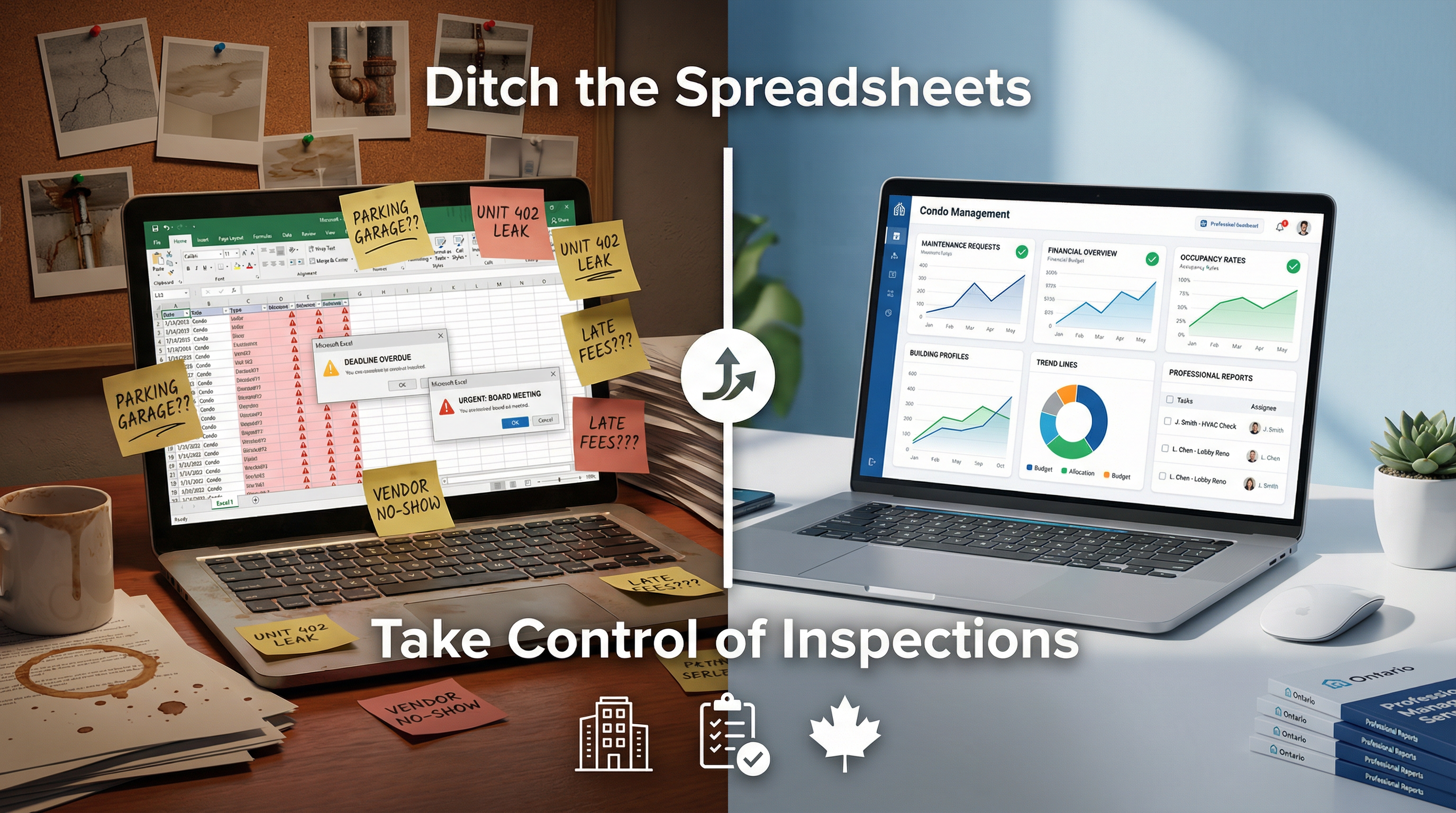
Spreadsheets, PDFs, email chains, and photos scattered across phones and folders — these aren't inspection systems. They're workarounds. And for years, the Ontario condo industry has treated them as 'good enough.' They're not.
Every condominium manager in Ontario has been there. Spreadsheets, PDFs, email chains, and photos scattered across phones and folders — these aren't inspection systems. They're workarounds. And the cracks are starting to show.
The Spreadsheet Trap Nobody Talks About
You open a shared drive, scroll past 47 versions of an inspection file, and still can't confirm when the last parking garage walkthrough was completed — or by whom.
Spreadsheets, PDFs, email chains, and photos scattered across phones and folders — these aren't inspection systems. They're workarounds. And for years, the Ontario condo industry has treated them as "good enough."
Why This Conversation Is Happening Now
The pressure on Ontario condominium managers has never been higher. Between CMRAO compliance expectations, increased insurer scrutiny, rising board governance standards, and the sheer complexity of managing multi-site portfolios, the tools managers rely on daily are being stress-tested — and they're failing.
- Boards Are Asking Harder Questions — They want structured, defensible inspection reports — not a spreadsheet with colour-coded cells and a few attached photos. The informal documentation that once satisfied governance requirements no longer meets the standard boards expect.
- Auditors and Insurers Are Digging Deeper — When a claim arises or a reserve fund study is reviewed, the first thing scrutinized is documentation quality. Fragmented records create liability exposure.
- Staff Turnover Erases Institutional Knowledge — When a superintendent leaves and their inspection notes live in a personal folder on a phone, continuity disappears overnight. The property doesn't just lose a staff member — it loses years of observational knowledge.
- Portfolio Managers Are Stretched Thin — Managing 5, 10, or 15 buildings with disconnected processes means recreating the same reports from scratch, week after week. The administrative burden multiplies with each property.
The industry has professionalized in virtually every other area — financial reporting, governance frameworks, legal compliance. Inspections remain the last major operational function still run on manual, improvised systems.
The Moment Everything Changed for Me
This realization didn't come during a crisis — it happened during routine work.
I was reviewing inspection requirements across multiple properties and portfolios, each with different histories, boards, and expectations. What should have been a straightforward task required cross-referencing emails, spreadsheets, prior reports, photos stored in different places, and notes that relied heavily on individual memory rather than structure.
What clicked wasn't frustration — it was recognizing the inefficiency and risk baked into the process. The inspections themselves were being done, but the way they were captured, tracked, and carried forward wasn't consistent or scalable. Each property depended too much on who was managing it at the time rather than on a system that supported continuity.
Sitting at my desk, walking through what was required versus what actually existed, it became clear that this wasn't a training issue or a diligence issue. It was a tooling issue. Managers were being asked to meet increasing regulatory, documentation, and liability expectations without infrastructure designed for condominium operations.
That was the moment everything aligned. Inspections needed to be treated as part of a formal workflow — structured, repeatable, defensible, and easy to maintain over time.
The Real Cost of "Good Enough"
Let's be honest about what fragmented inspection processes actually cost:
- Time — Managers routinely describe recreating the same reports over and over, copying and pasting findings into board packages, and manually tracking which deficiencies were addressed. Hours per week — sometimes hours per building — are lost to administrative tasks that should be automated.
- Consistency — When every property in a portfolio uses a slightly different inspection format — or worse, no consistent format at all — comparison across buildings becomes impossible. You can't identify trends, benchmark conditions, or make strategic maintenance decisions without standardized data.
- Defensibility — This is the one that keeps experienced managers up at night. If a slip-and-fall claim leads to litigation, if a board questions why a known deficiency wasn't escalated, if an insurer challenges a renewal — the quality of your inspection records becomes your first line of defense.
- Accountability — Who inspected what? When? Against which standard? Were findings reviewed? Was follow-up assigned? In a spreadsheet-based workflow, these questions often don't have clear answers.
I've been on site at a property, following up on an issue that had escalated beyond day-to-day operations, asked to walk through inspection history and supporting documentation. On paper, inspections had been "done." In practice, the records were fragmented, inconsistent, and difficult to rely on with confidence.
What stood out wasn't that something had been missed — it was realizing how exposed the corporation, the manager, and ultimately the board were because the inspection process itself wasn't defensible. Good intentions and experience don't replace clear, repeatable, well-documented processes.
What a Centralized Inspection Platform Actually Changes
The shift from spreadsheets to a purpose-built inspection platform isn't about adopting flashy technology for its own sake. It's about embedding inspections as a defined, repeatable, governance-aligned operational step — not an isolated task that lives outside your core workflow.
- Structured Building Profiles — Instead of maintaining separate files for each property, a centralized platform allows managers to create dedicated building profiles that capture common elements, asset categories, systems, and property-specific characteristics — all in one place.
- Standardized Inspection Templates — Rather than reinventing the checklist for every walkthrough, managers use predefined templates aligned with Ontario condominium operations. Every inspection captures the same categories of information, regardless of who performs it.
- Real-Time Deficiency Documentation — Findings are recorded at the point of observation — with structured categorization, not just a photo and a note. Deficiencies are immediately tied to the building, the asset, the inspection date, and the person who documented them.
- Trend Tracking Over Time — When inspections are captured consistently, managers can identify recurring issues, track deterioration patterns, and support reserve fund planning with actual data rather than assumptions. Boards stop asking "what's wrong?" and start asking "what should we prioritize?"
- Board-Ready Reports — No more spending Friday afternoon reformatting spreadsheet data into a presentable board package. A centralized platform generates clear, professional inspection reports that boards, auditors, insurers, and legal counsel can rely on — without manual assembly.
- Actionable Task Lists — Inspection findings don't just sit in a report. They're converted into task lists that drive follow-up, assign accountability, and create a documented chain of action. The gap between "identified" and "addressed" finally closes.
The Objection: "Our Current Process Works Fine"
This is the most common hesitation — and it's understandable. Experienced managers have built careers using the tools available to them. Spreadsheets, email, shared drives — they've made it work.
But "working" and "defensible" are not the same thing.
The real question isn't whether your current process gets inspections done. It's whether your current process can:
- Survive an audit without requiring hours of reconstruction
- Withstand a legal challenge where documentation quality is central
- Scale across a growing portfolio without multiplying your administrative workload
- Maintain continuity when staff change or responsibilities shift
- Demonstrate to boards and insurers that inspections are a governed, structured process — not an informal habit
If the answer to any of those is uncertain, the process isn't fine. It's fragile.
Why Generic Tools Miss the Mark
Some managers have tried general-purpose inspection apps — tools built for construction, facilities management, or industrial environments. The experience is usually the same: too broad, too complex, and not aligned with how Ontario condominiums actually operate.
Condominium inspections aren't the same as warehouse safety checks. The governance framework is different. The stakeholders are different. The documentation standards are different. The consequences of getting it wrong are different.
- Reflects Canadian condominium governance and compliance realities
- Supports common element inspections as they're actually performed
- Produces reports that make sense to boards, auditors, and insurers — not project managers on a construction site
- Treats inspections as a core operational function, not an add-on feature buried in a general platform
The Shift Is Operational, Not Just Technological
The most important thing to understand about moving to a centralized inspection platform is that it's not a technology decision — it's an operational one.
It's the decision to stop treating inspections as informal tasks and start treating them as structured, governed, documented processes that protect the manager, the corporation, and the residents.
It's the same evolution the industry made with financial reporting. No board would accept a treasurer managing corporation finances in a personal spreadsheet. Why do we still accept that standard for building inspections — the process that directly protects physical assets and human safety?
Getting Started Without Disruption
One of the biggest concerns managers have is that switching systems will create short-term chaos. That's a valid concern — but it's also a solvable one.
The key is choosing a platform that mirrors how you already work, not one that forces you into a completely foreign workflow. Look for:
- Templates that match your existing inspection categories so you're not starting from zero
- Simple onboarding that doesn't require weeks of training for staff
- Flexibility for your team — managers, superintendents, and maintenance staff should all be able to participate without friction
- Immediate value in the form of cleaner reports, faster documentation, and reduced rework from day one
The transition doesn't have to be all-or-nothing. Start with one building. Run one inspection cycle. Compare the output to what you were producing before. The difference will be obvious.
Why I Built Condo Inspect Pro
After 20 years managing condos, I got tired of watching property managers miss inspections, scramble before board meetings, and rely on spreadsheets that fall apart.
Condo Inspect Pro was built by a property manager, for property managers. It reflects the actual workflows, governance expectations, and documentation standards of Ontario condominium operations — because that's the industry I've worked in my entire career.
This isn't a generic tool adapted for condos. It was purpose-built from the ground up to solve the specific problems condominium professionals face every day.
Condo Inspect Pro helps condominium managers replace fragmented inspection workflows with structured, repeatable, defensible processes. From building profiles and standardized templates to board-ready reports and deficiency tracking — everything is designed for Ontario condo operations. Explore why Ontario managers choose purpose-built inspection software, read common questions from condominium professionals, or contact us for a demo.
Start with one building. See the difference for yourself.
This article reflects the author's professional experience in Ontario condominium management. Consult your property management team and legal counsel for specific guidance applicable to your properties.
Frequently Asked Questions
Why are spreadsheets inadequate for Ontario condominium inspections?
Spreadsheets create fragmented documentation that cannot survive audits, legal challenges, or staff turnover. They lack timestamped photo evidence, structured condition assessments, and automated follow-up tracking.
What are the risks of fragmented inspection documentation?
Fragmented documentation creates liability exposure when claims arise, makes it impossible to demonstrate due diligence during CMRAO reviews, erases institutional knowledge when staff change, and forces reactive decision-making.
How does purpose-built inspection software differ from generic tools?
Purpose-built condominium inspection software understands Ontario governance frameworks, condo types, fire code requirements, and board reporting standards. Generic tools lack the compliance templates and reporting formats that Ontario condominium operations require.
Can condominium managers transition to digital inspections without disruption?
Yes. Start with one building, run one inspection cycle, and compare the output. Templates that match existing inspection categories and simple onboarding reduce transition friction.
What should Ontario condo managers look for in inspection software?
Look for Ontario-specific compliance templates, offline capability, automated deficiency tracking, board-ready PDF reports, building profile-driven inspection generation, and a platform designed specifically for condominium operations.