Beyond the Clipboard: Spring Inspections — What Most Managers and Boards Are Missing
· By Sunni Dowds · Inspections
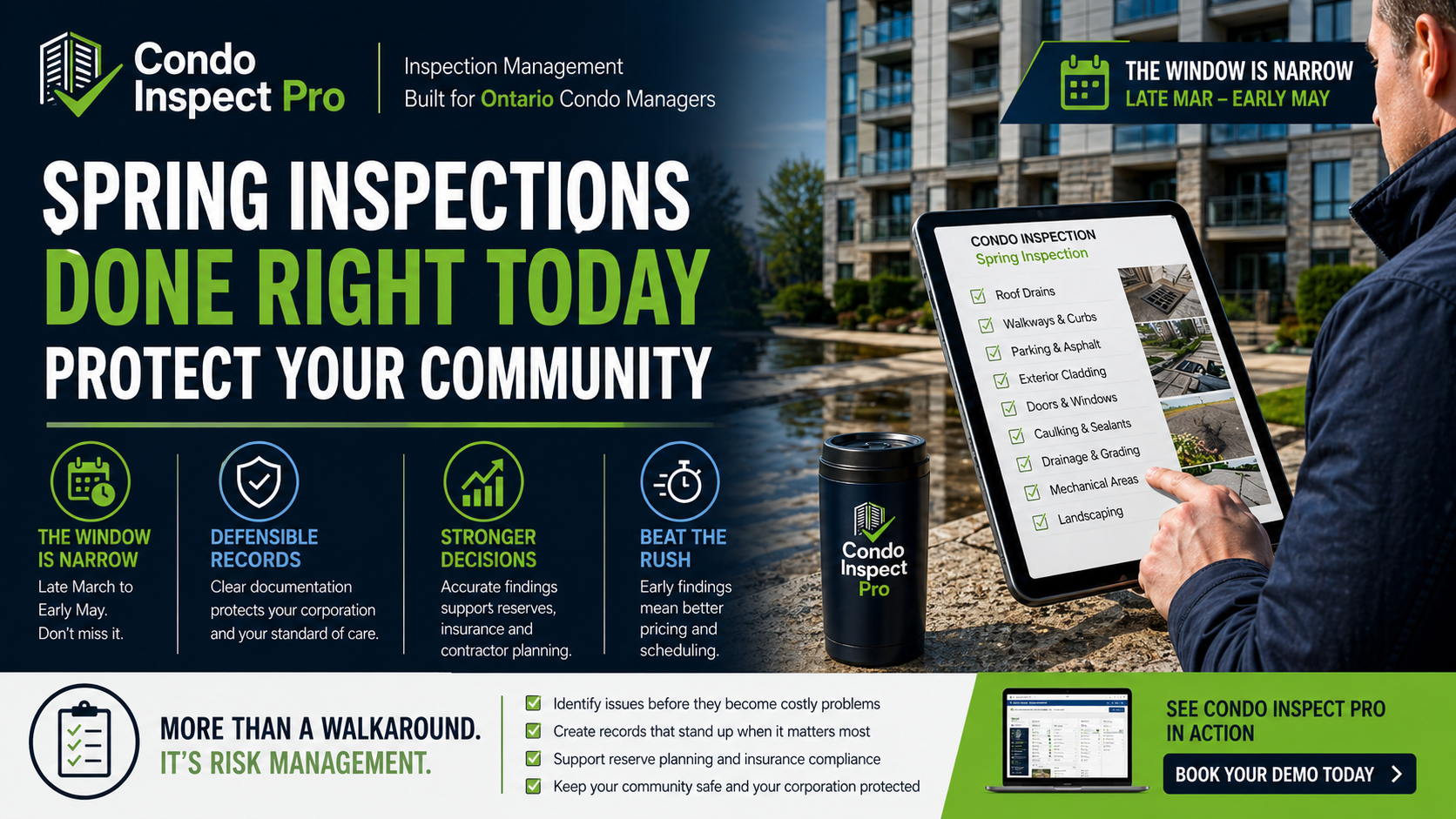
Spring inspection season arrives the same time every year. Most managers know it is coming. Most boards know it happens. And yet the same gaps play out across buildings of every size and type — four things about spring inspections that rarely get talked about, each with a real impact on the corporation.
Spring inspections are not just a maintenance exercise. What you find, when you find it, and how you document it has consequences that reach well beyond the repair itself.
Spring inspection season arrives the same time every year. Most managers know it is coming. Most boards know it happens. And yet, after years of working in Ontario condominium management, I still see the same gaps play out across buildings of every size and type.
Not because managers are not doing the work. They are. But there are four things about spring inspections that rarely get talked about — and each one has a real impact on the corporation, the board, and the owners who live there.
1. The Impact You May Not Be Thinking About
Most managers approach spring inspections as a maintenance exercise. Walk the property, note what needs fixing, get the contractors in. That is the right instinct — but it stops short of what the inspection can actually do for the corporation.
What you find in spring — and how you document it — has a direct impact on three things that extend well beyond the repair itself.
Reserve fund accuracy. The conditions you observe and record in spring are current-condition data. When a reserve fund study is being updated, or when a Performance Inspection Certificate is being prepared, that data is what separates a plan built on real numbers from one built on assumptions. A documented spring finding that shows accelerated deterioration of a parking structure membrane or drainage infrastructure is information the engineer needs. Without it, the reserve fund plan is based on scheduled assumptions rather than observed reality.
Insurance positioning. Corporations that can demonstrate a documented inspection program — regular, thorough, retrievable — are in a stronger position when a claim arises. An insurer looking at a water damage claim will ask what the corporation knew and when. A spring inspection record that shows the drainage system was assessed and found to be in good condition, or alternatively that a deficiency was identified and a work order was issued, is documentation that speaks directly to the standard of care question.
Contractor timing. Spring is the busiest season for every trade that services condominium common elements. Roofing, waterproofing, concrete repair, asphalt, landscaping — every contractor is booking out from the moment the ground thaws. The corporation that has a documented deficiency list from a March or April inspection is the one that gets on the schedule. The one that is still pulling together findings in June is competing for September availability.
2. The Window Is Narrower Than You Think
There is a specific window in spring — late March through early May in Ontario — where conditions are right to find winter damage before it compounds and before contractors are fully booked. That window is not flexible. It is determined by thaw timing and contractor availability, not by when the manager's schedule opens up.
A fall inspection is about winterizing — checking that the building is prepared for what is coming. A spring inspection is the opposite: it is about assessing what winter left behind. Freeze-thaw damage to concrete and asphalt, drainage blockages, membrane deterioration, heaved walkways, failed caulking. These are different checklists with different findings and different follow-through requirements.
Too early, and snow and ice are still concealing the damage. Too late, and the damage that was findable in April has become a water intrusion in June, a surface failure in July, or a trip hazard that a resident has already encountered.
I have seen buildings where a spring inspection was delayed until June because the manager was managing competing priorities across multiple sites. By the time the inspection happened, the roof drain that would have been a $1,500 cleanout had backed up, caused damage to the roof membrane, and was now a $15,000 repair conversation with the board.
Timing is not a scheduling preference. It is a risk management decision. Getting the inspection done in the right window — and having the documentation to show it — is the difference between catching a problem and inheriting one.
The other timing dimension most managers underestimate is the time required after the inspection. Compiling findings, attaching photos, preparing the deficiency list, drafting the board summary — that is hours of work that happens after you leave the property. If your inspection happens in late April and your board meeting is in early May, the time between the walkthrough and the board package is your real constraint. Plan for it.
3. The Team Discussion That Should Happen Before the Inspection
The spring inspection is usually thought of as a manager's task. In practice, the most useful spring inspections involve more than one set of eyes — and the conversation needs to happen before the walkthrough, not after.
Superintendents and on-site staff have spent the winter watching the building. They know where the ice backed up against the loading dock door. They know which drain took longest to clear after a thaw. They know which unit owners reported drafts or condensation in January. That information is inspection intelligence, and most of it never makes it into a formal spring inspection record because no one asked.
Before the inspection, I always have a conversation with the superintendent. What did you see this winter that concerned you? Where did you have to address something repeatedly? What has been reported by owners that we have not fully resolved? That conversation shapes the inspection.
Contractors who have been on site through winter are another source of intelligence. The elevator contractor, the HVAC service provider, the fire inspection company — they have all been in mechanical spaces, machine rooms, and utility areas that the manager may not access on every visit. A quick check-in before spring inspection season costs nothing and frequently surfaces something worth investigating.
The spring inspection is not a solo exercise. The manager who treats it as one is leaving information on the table.
4. How to Bring Findings to the Board — and Get Action
This is where most spring inspections lose their value. The work is done. The deficiencies are identified. The photos are taken. And then the manager presents the findings to the board in a way that results in a motion to defer, a request for three contractor quotes that takes four months, and a deficiency that is still open at the fall inspection.
Boards are not engineers or building science professionals. When a manager presents a list of deficiencies without context, directors do not know how to prioritize. Everything looks either urgent or deferrable, and without guidance, deferrable wins.
Frame findings by risk, not by trade. Instead of grouping deficiencies by area or contractor type, group them by urgency and consequence. What needs to be addressed before the next rainfall. What can be scheduled for summer. What should be noted for the reserve fund study. Directors can act on that framing. They struggle with a flat list of fourteen items in no particular order.
Connect findings to the reserve fund. When a spring inspection finding has reserve fund implications — a component deteriorating faster than the current study anticipates, a repair that may trigger a larger scope of work — say that explicitly in the board presentation.
Put it in writing before the meeting. A board summary distributed ahead of the meeting gives directors time to read it, formulate questions, and come prepared to make decisions. A verbal presentation at the table puts everyone on the spot and rarely results in clear direction.
Follow through visibly. After the board meeting, the deficiency list with approved actions, assigned contractors, and timelines should be a living document that is updated and reported on at subsequent meetings. Boards that see deficiencies move from open to resolved develop confidence in the inspection process.
The Record Is What Makes It All Work
Every one of these four areas — impact, timing, team coordination, board communication — depends on the same foundation: a complete, organized, retrievable inspection record.
The inspection that happens in the right window, informed by the right conversations, presented to the board in a way that drives decisions, and documented in a format that can be produced when it matters — that is what a spring inspection is supposed to be.
Download the free spring inspection checklist that matches your property type at condoinspectpro.com/inspection-checklist. Available for: Standard Condominium (Mid-Rise and High-Rise), Low-Rise, Townhouse, Common Elements Condominium (CEC), and Vacant Land Condominium.